- Location:79 13th Ave NE Suite 207 Minneapolis, MN 55413

2027 Technology Planning for Behavioral Health: What to Review Before You Finalize Your IT Budget
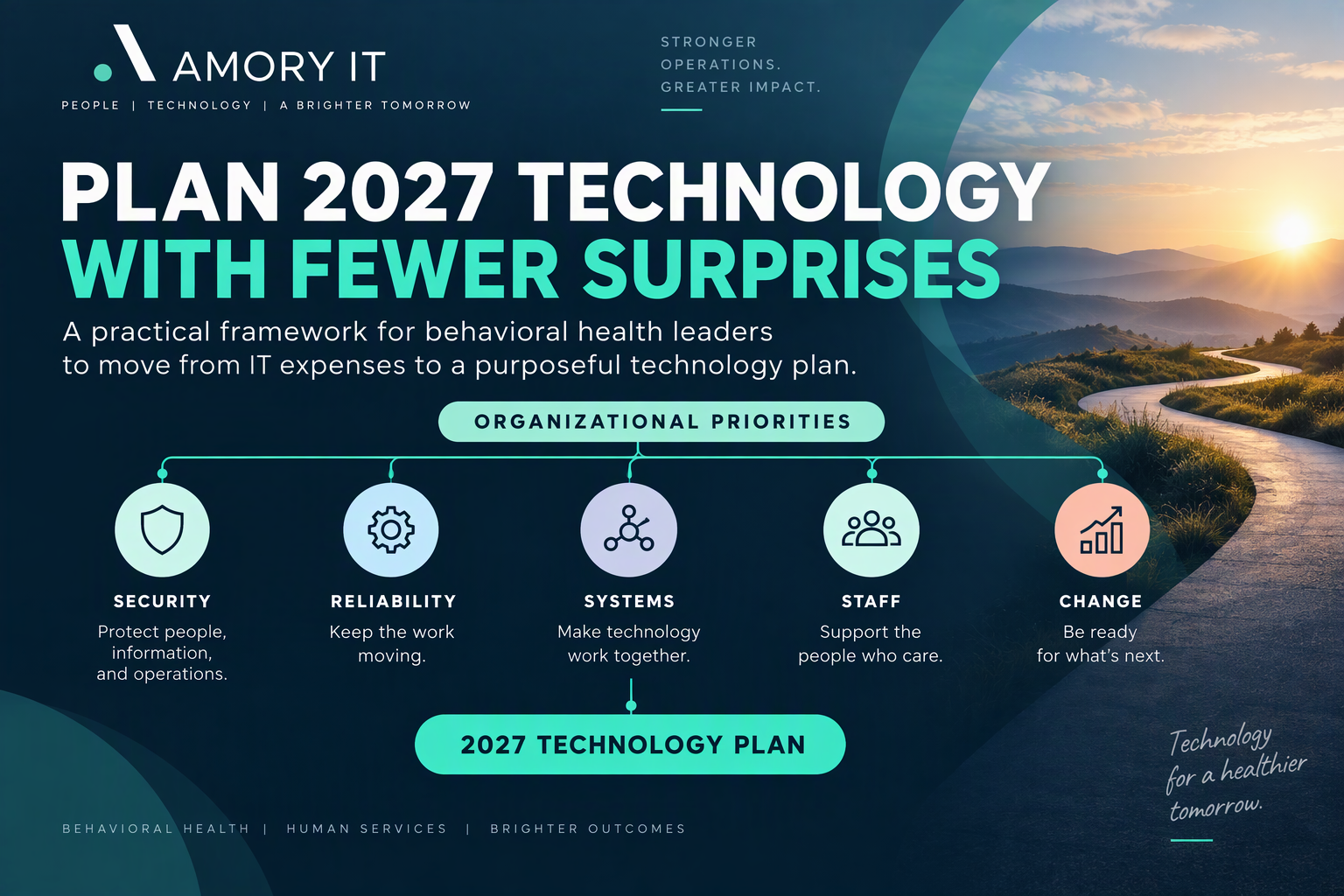
It’s easy for technology budget planning to become an exercise in updating last year’s numbers.
Software renewals. Support. Hardware replacements. Known projects. A little room for whatever changes next year brings.
Those numbers matter. But before leadership finalizes the 2027 technology budget, there is another question worth asking:
What does our organization need technology to support in 2027?
For behavioral health and human-services organizations, technology is part of the operating environment. It can affect how staff access systems, how different platforms work together, whether technology is reliable enough for everyday work, how security responsibilities are handled and whether upcoming organizational changes create technology dependencies.
A useful technology review therefore needs to look beyond the purchasing list.
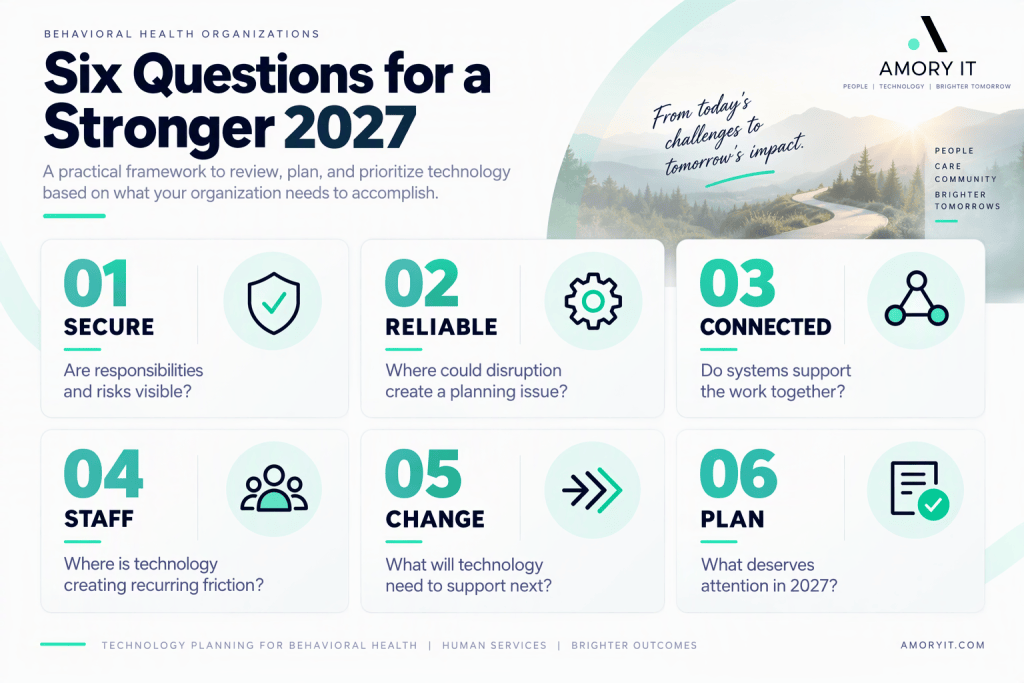
Here are six areas to work through.
EXECUTIVE SUMMARY
A useful 2027 technology budget should reflect more than recurring invoices and known purchases.
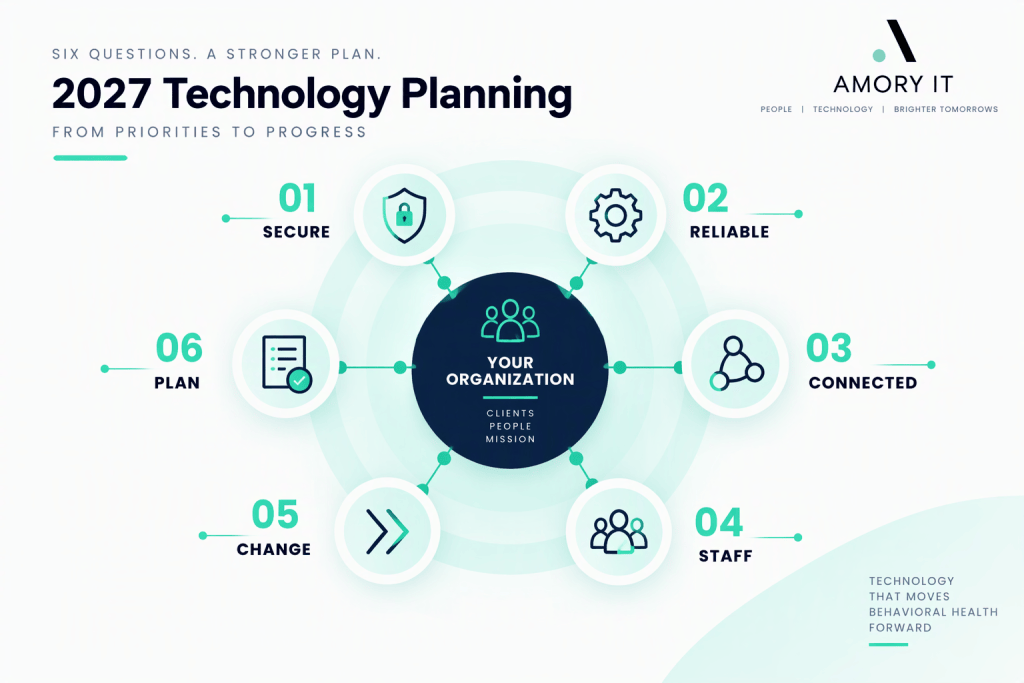
Before finalizing it, review six connected areas:
Security · Reliability · Systems · Staff · Change · Plan
The goal is not to turn leadership into the IT department. It’s to make important decisions, uncertainties and dependencies visible early enough to plan around them.
01 IS IT SECURE?
Leadership does not need to personally evaluate every security control.
Leadership should, however, know whether responsibility is clear, material risks are being reviewed and important security work has a place in the plan.
For organizations subject to the HIPAA Security Rule, current federal regulations require covered entities and business associates to conduct an accurate and thorough assessment of risks and vulnerabilities to electronic protected health information. HHS describes that risk analysis as foundational to identifying and implementing appropriate safeguards. [hhs.gov], [ecfr.gov]
Leadership review
- Is responsibility for important security decisions clear?
- Are identity, access, devices, email and remote work being managed deliberately?
- Are backup, continuity and incident readiness visible in the plan?
- Are security and privacy considered when significant technology or vendor decisions are made?
- Which known security priorities need leadership attention or budget in 2027?
The point is not to make every possible security improvement a project.
The point is to know what needs attention, what needs additional review and who owns the next decision.
For organizations subject to 42 CFR Part 2, HHS states that Part 2 protects the confidentiality of qualifying substance use disorder patient records. Part 2 generally applies to federally assisted programs providing SUD diagnosis, treatment or referral for treatment, with some requirements also applying to certain recipients of Part 2 records. [hhs.gov], [ecfr.gov]
•
02 Is it reliable?
Some technology costs arrive as invoices.
Others appear as interruptions.
A familiar support problem that keeps returning. Aging equipment no one has planned to replace. A system that periodically slows the work down. An important point of failure that is understood informally but not reflected in the budget.
Leadership review
- Which systems and technology services are essential to everyday operations?
- Where are recurring technology issues consuming staff attention?
- What devices or infrastructure are approaching replacement?
- Where does the organization have an important dependency or point of failure?
- Are backup, continuity and upcoming technology changes part of the planning conversation?
Not every interruption is preventable.
The planning opportunity is to identify what can reasonably be anticipated before it becomes another unplanned project.
Some technology costs arrive as invoices. Others appear as interruptions.
Recurring issues, lifecycle needs and workarounds belong in the planning conversation even when they aren’t obvious budget line items.
03 Does it work together?
A collection of individually capable systems can still create an inefficient operating environment.
For this review, leadership does not need to examine every integration.
Instead, look at how technology supports the work between systems and teams.
For example:
- Are important systems exchanging information as intended?
- Where are staff re-entering information?
- Where has a manual handoff become the normal process?
- When a workflow crosses multiple systems or vendors, is responsibility clear?
- Are software renewals, migrations or vendor changes likely to affect existing workflows?
In behavioral health, these questions may surface around an EHR/EMR and the systems or processes that interact with it. But the important planning issue is the interconnected environment, not a particular product.
Not every manual process needs automation, and not every system needs integration.
The goal is to distinguish intentional choices from workarounds nobody has stepped back to review.
This reflects the November campaign’s central differentiation: behavioral-health specialization should improve the planning conversation by putting technology decisions in operational context instead of evaluating them in isolation.
•
04 Does it work for staff?
A technology environment can technically be functioning and still create unnecessary work.
Ask the people using it:
Where is technology making the work harder than it needs to be?
Look for recurring patterns:
- access or permission problems
- repeated manual steps
- inconsistent onboarding or role changes
- familiar support issues that keep returning
- workarounds that have quietly become standard
- remote or mobile workflows that no longer fit the way people work
Not every frustration warrants a purchase.
Repeated friction does warrant understanding.
The underlying issue might be technology. It might be configuration, process, training or an intentional trade-off.
That distinction should come before deciding what to buy.
This fits the approved human-centered Amory belief that technology should demand less attention from staff so the organization’s attention can remain on its work and the people it serves.
05 What is changing?
Last year’s expenses describe technology you already have.
The 2027 plan also needs to account for what is coming.
Leadership review
Consider changes such as:
- organizational growth
- a new program or service
- another site or location
- staffing changes
- a significant software decision
- vendor changes
- infrastructure replacement
- changes in how or where staff work
- new security priorities
Each could create technology decisions that aren’t obvious from reviewing last year’s invoices.
The useful planning question is:
What will this organizational change require technology to support?
That is enough for this section.
AI review prompt
If AI use or interest is relevant, add it to the review rather than creating a separate technology-shopping exercise:
- Where could AI legitimately help?
- What tools are appropriate or approved?
- What information might people place into those tools?
- Who owns governance?
- What security, privacy or data-handling questions require qualified review?
The checklist keeps AI at this governance/planning level intentionally. The approved campaign brief likewise positions AI as something leadership should decide how to address in the 2027 plan, not as a standalone AI implementation guide.
GROWTH
SERVICES
LOCATIONS
STAFFING
SYSTEMS
AI
What technology decisions could these changes create?
•
06 What is the plan?
After reviewing the environment, bring the findings down to a manageable number of priorities.
For each one, identify:
What needs attention?
Why does it matter?
Who owns the next decision?
Who else needs to participate?
What must happen first?
When does a decision need to happen?
What budget needs to be considered?
Not every finding becomes a project.
Some should be addressed now.
Some belong in the 2027 roadmap.
Some need investigation.
Some simply need monitoring.
And Not Sure is a useful result when it reveals an important decision that lacks ownership or enough information.
PUT THE REVIEW INTO PRACTICE
2027 Behavioral Health
Technology Planning Checklist
Technology Planning Checklist
Use the four-page leadership worksheet to work through the review and turn your findings into three priorities for 2027.
●
Confident
◆
Needs Review
○
Not Sure
Download the Checklist
4-page executive planning worksheet · PDF

Frequently Asked Questions
These questions address several common issues that arise when behavioral health leaders plan technology spending and priorities.
What should a behavioral health organization include in its IT budget?
Budget for known recurring technology expenses and expected projects, but also account for lifecycle and replacement needs, security priorities, significant system or vendor changes, and technology requirements created by organizational changes.
The exact budget will vary by organization. The planning process should make those requirements visible before the numbers are finalized.
How should leaders prioritize cybersecurity spending?
Start with the organization’s actual environment, risks, responsibilities, and operational priorities rather than a generic product list.
For organizations subject to the HIPAA Security Rule, risk analysis is a required part of the security-management process. HHS describes risk analysis as foundational to identifying and implementing appropriate safeguards for electronic protected health information.
What technology costs are easy to overlook?
HHS states that risk analysis is the first step in identifying and implementing safeguards under the HIPAA Security Rule. The regulation requires covered entities and business associates to conduct an accurate and thorough assessment of potential risks and vulnerabilities to the confidentiality, integrity, and availability of electronic protected health information. [hhs.gov], [ecfr.gov]
What technology costs are easy to overlook?
Not every technology cost appears as a new purchase.
Lifecycle replacement, recurring support problems, staff time spent on workarounds, implementation requirements, vendor dependencies, and unexpected projects can all affect the planning picture.
How can managed services support more predictable technology planning?
A managed-services relationship can help make planning and spending more predictable when scope, responsibilities, and roadmaps are clear.
Regular planning conversations can also make known lifecycle needs, upcoming projects, vendor responsibilities, and unresolved priorities easier to see before the budget is finalized.
Managed services do not eliminate surprises or guarantee fixed technology costs.
A good technology budget does not need to predict everything that will happen. It should make the important things easier to see.
If the six-question review raises something you’d like another perspective on, reach Amory at info@amoryit.com or through Contact Us.