- Location:79 13th Ave NE Suite 207 Minneapolis, MN 55413

Staff Retention & IT Strategy: The Silent Sentry Model
Contributor: Amory IT Strategy Team
Reading Time: 6 Minutes
Executive Summary: Technical friction is the “silent burnout” factor in behavioral health leadership. This guide shifts the perspective from seeing Managed Services as a utility to seeing it as a critical pillar of staff retention and organization stability. Discover how a “Silent Sentry” model protects your most valuable asset: your team.
The Hidden Cost of “Good Enough” IT: Why Tech Friction is Sidelining Your Mission
In the high-stakes environments of SUD and Elder Care, every minute counts. Yet, many Executive Directors are losing hours each week to “low-level” tech friction—password resets, suspicious email alerts, and slow response times. This isn’t just an IT issue; it’s a leadership crisis. When your staff has to fight their tools to do their jobs, the quality of care for the client inevitably suffers.
The “Silent Sentry” vs. The Help Desk
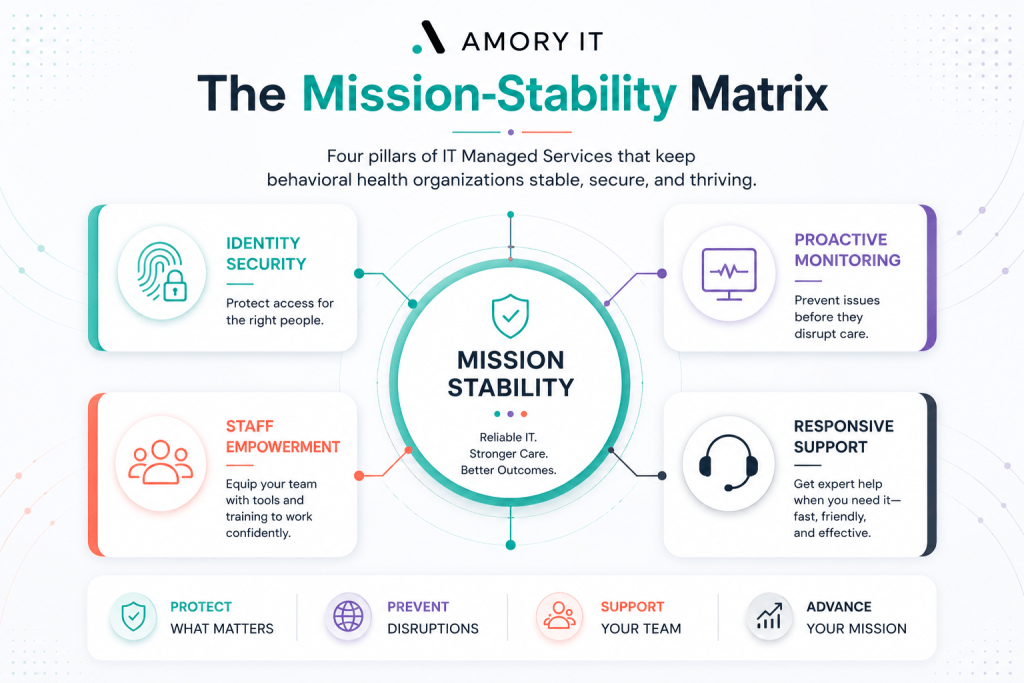
Most IT support is reactive. It waits for your staff to break their flow, open a ticket, and wait. At Amory IT, our Managed Service Provider (MSP) model is built on being Accountable before the friction starts. We call this the Silent Sentry.
- Identity Sovereignty: Instead of just “fixing an email,” we manage the entire digital identity of your organization. This ensures that the trust your staff has in their communication is never shaken.
- Response as a Core Value: In your world, “Responsive” isn’t just a buzzword. If a facility’s network goes down, it impacts client safety. We align our engineering priorities with your mission’s urgency.
- Empathetic Infrastructure: We design systems that understand the user. Your staff shouldn’t need a degree in computer science to securely share a customer file.
The CARE Pull Quote: “A specialized MSP doesn’t just manage hardware; we manage the mental bandwidth of your team. By being Accountable for the tech, we grant your staff the freedom to be fully present for the client.”
Breaking the Burnout Cycle
Staff retention in the care sector is often tied to “meaningful work.” Nothing strips the meaning out of a workday faster than a tech hurdle that feels avoidable. By integrating proactive IT Managed Services, you are making an Empathetic investment in your team’s daily experience.
Leadership Audit: Is your IT a Support or a Burden?
- Does your staff feel confident that an “urgent” request from leadership is authentic? (See our guide on the Trust Shield).
- How many hours a week does your leadership team spend acting as a “middle-man” between staff and tech support?
- Is your current MSP providing guidance from recognized security frameworks, or are they just putting out fires?

The Decision: Utility vs. Strategy
Generalist IT support treats your organization like any other business. But you aren’t any other business. You are a sanctuary for clients and a mission for your staff. Choosing a partner who is Caring, Accountable, Responsive, and Empathetic means choosing a partner who values your outcomes as much as you do.
The Choice is Clear:
- Reactive: High friction, staff frustration, and “hope-based” security.
- Proactive (The Amory Standard): Low friction, mission-focused staff, and identity-based protection.
Is your technology an extension of your care, or a barrier to it?