- Location:79 13th Ave NE Suite 207 Minneapolis, MN 55413

Human-Centered Cybersecurity: Protecting Care Organizations Without Slowing Down Your Staff
Contributor: Amory IT Team
Reading Time: 6 Mins
Executive Summary: Every October during Cybersecurity Awareness Month, leadership across substance use disorder recovery, developmental disability support, and elder care organizations face high-stakes compliance demands that can pull focus from direct care. This strategy guide outlines how a specialized managed service provider replaces generic, rigid IT policies with human-centered security built around direct care workflows. Learn how your organization can eliminate technical friction, protect sensitive client data, and partner with an msp guided by empathy.
Human-Centered Cybersecurity: Protecting Care Organizations Without Slowing Down Your Staff
Imagine it’s mid-afternoon on a busy Tuesday. A direct care staff member at a substance use disorder (SUD) facility is right in the middle of an intensive planning session with a client. Out of the corner of their eye, an urgent security pop-up flashes on screen: ‘Account Suspended—Click Here to Verify Login.’
Because their entire attention is dedicated to supporting the person sitting right in front of them, they click to dismiss the pop-up so they can keep working. Within three seconds, a quiet wave of stress sets in: ‘Did I just open something I shouldn’t have?’
Whether your organization provides elder care, supports individuals with developmental disabilities (IDD), or guides clients through recovery, tech friction is never just a minor computer inconvenience. When technology gets in the way, it directly disrupts care delivery and adds unnecessary anxiety to an already demanding environment.
Rethinking Security During Cybersecurity Awareness Month
This Cybersecurity Awareness Month, the tech industry is filling social feeds with frightening headlines and rigid compliance rules. But in behavioral health, cybersecurity isn’t about fear or corporate rulebooks—it’s about safeguarding human dignity and protecting organizational trust.
According to technical security guidance from the U.S. Department of Health & Human Services (HHS), administrative and technical safeguards must be integrated into daily operations to protect sensitive client records effectively. Furthermore, workplace culture recommendations from the Cybersecurity and Infrastructure Security Agency (CISA) highlight that fostering an open, supportive environment is far more effective at preventing security breaches than restricting user access with overly complex technical barriers.
As a specialized managed service provider, we know that generic corporate IT policies fail in human services. Your staff isn’t sitting at a desk all day analyzing spreadsheets; they are delivering compassionate, hands-on support. When security tools slow down essential software or lock staff out during client interactions, team members naturally find workarounds—not to break rules, but because their priority is always their clients.
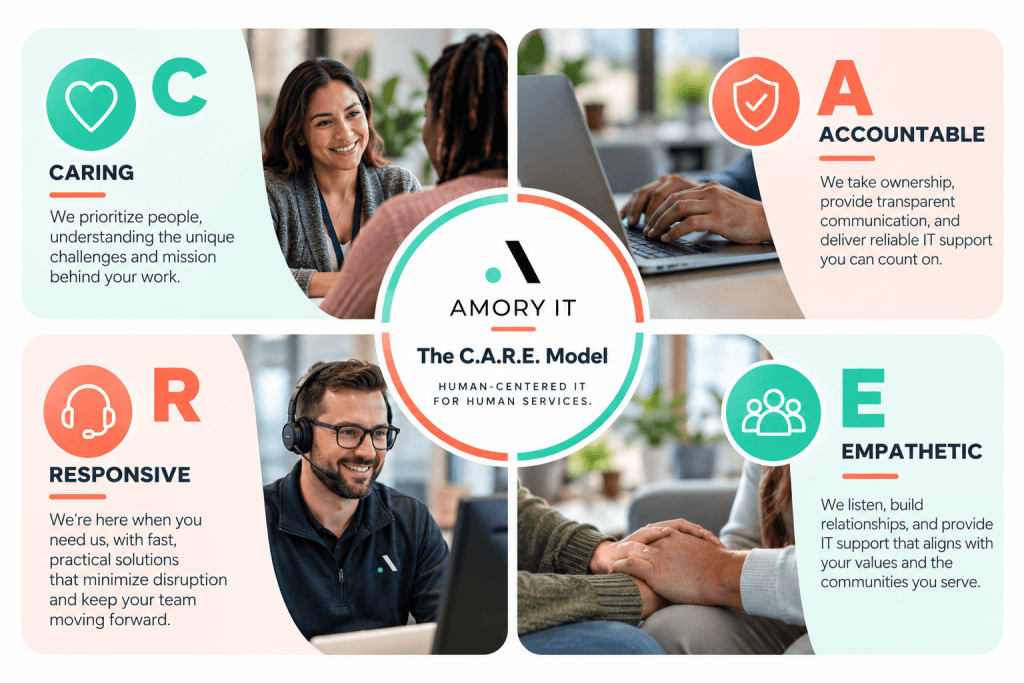
“Cybersecurity should never stand between a dedicated staff member and a customer who needs support. Our CARE framework—Caring, Accountable, Responsive, and Empathetic—ensures our managed services act as an invisible safety net, protecting sensitive data while empowering your mission.”

Problem vs. Fix: Aligning IT Managed Services with Behavioral Health
When care organizations rely on generalist IT support, standard security rules often collide with daily workflows. Here is how specialized it managed services solve real operational pain points across SUD, IDD, and elder care settings:
- Problem: Complex password rotations and constant re-authentication force staff to write down credentials or experience delays while logging into client management systems during home visits or residential rounds.
- Fix: A dedicated managed service provider configures single sign-on (SSO) and role-based access, allowing staff to move between platforms securely with zero wasted time.
- Problem: Staff fear administrative reprimand if they accidentally click a suspicious email link, leading to delayed reporting and increased security risk for the organization.
- Fix: Empathetic managed services establish a culture of psychological safety. Staff are encouraged to report potential issues immediately so your msp team can isolate threats rapidly without assigning blame.
- Problem: Off-the-shelf security software triggers unexpected computer restarts and intrusive pop-ups during family consultations or client intake evaluations.
- Fix: Specialized IT support manages maintenance schedules quietly behind the scenes, ensuring system health without interrupting client care.
To learn more about optimizing technical frameworks across care environments, explore our insights on building resilient IT infrastructure for human services organizations.
Comparing Generalist IT vs. Amory IT Specialist MSP
Not all managed services align with the unique realities of human services. Behavioral health organizations need an IT partner who understands regulatory compliance, electronic health records, and the human element of care delivery.
| Operational Priority | Generalist Corporate MSP | Amory IT (Specialist MSP) |
|---|---|---|
| Operational Approach | Enforces rigid corporate policies and one-size-fits-all technical restrictions. | Designs flexible, human-centered security around real care workflows. |
| Culture & Communication | Views technical workarounds as compliance failures; treats staff punitively. | Built on the CARE model (Caring, Accountable, Responsive, Empathetic). |
| Security Philosophy | Relies heavily on complex locks, frequent logins, and user restrictions. | Fosters psychological safety and rapid, non-punitive event reporting. |
| Industry Expertise | Broad focus across general retail, legal, and commercial businesses. | Specialized exclusively in SUD, IDD, Elder Care, and Behavioral Health. |
3 Actionable Steps to Strengthen Security Culture This Month
Leadership can take practical, encouraging steps during Cybersecurity Awareness Month to enhance security without creating unnecessary friction for staff:
- Promote Open Communication: Reframe how your team views security. Emphasize that notifying your managed service provider immediately about potential errors protects the entire organization and every client you serve.
- Simplify System Access: Work with your msp to implement single sign-on tools, removing password friction for staff who navigate multiple documentation systems daily.
- Partner with a Care-Focused MSP: Choose an it managed services partner who treats cybersecurity as a natural extension of quality client care rather than a set of rigid technical hurdles.
Cybersecurity Awareness Month
Protect the Technology That Empowers Your Mission
Cybersecurity shouldn’t mean overwhelming technical rules, anxious staff, or disrupted care. Partnering with a specialized managed service provider gives your organization complete technical confidence while protecting sensitive client records.
1. Download the Checklist
A non-technical, self-guided security checklist designed specifically for behavioral health leadership.
2. Take the Quick Assessment
Complete a fast online posture evaluation. Our specialized msp team will analyze your setup and follow up directly with your custom results and tailored solutions.
Need immediate IT support or custom strategy for your organization? Contact our team today.