- Location:79 13th Ave NE Suite 207 Minneapolis, MN 55413

The Human Services Guide to Evaluating Managed Services: Navigating Rural Reach & Telehealth
Contributed by: The Amory IT Strategy Team
Reading Time: 6 minutes
Published: July 23, 2026
If your mobile staff spends more time troubleshooting dropped video sessions and locked EHR screens in rural county driveways than they do supporting client recovery, your technology isn’t built for your mission. Most general corporate technology vendors promise impressive statistical uptimes, but those metrics mean very little when an elder care worker or substance use counselor is stuck on a volatile cellular connection trying to update a critical care plan in the field.
To expand your organization’s rural reach without risking data breaches or burning out your teams, a generic corporate IT support package will not suffice. You need an intentional framework designed for community care. This guide provides your executive leadership team with an objective roadmap to evaluate external technology partners, ensuring your next IT investment honors your team’s dedication, protects your data, and fits your budget.
Executive Summary
When expanding your organization’s rural reach, traditional corporate IT checklists miss the mark. This strategic blueprint moves past generic metrics to hand executive directors an objective evaluation matrix. Below, we outline how to audit a potential partner’s approach to low-bandwidth stabilization, mobile data privacy compliance, and human support structures before signing an agreement.
Auditing for Low-Bandwidth Realities
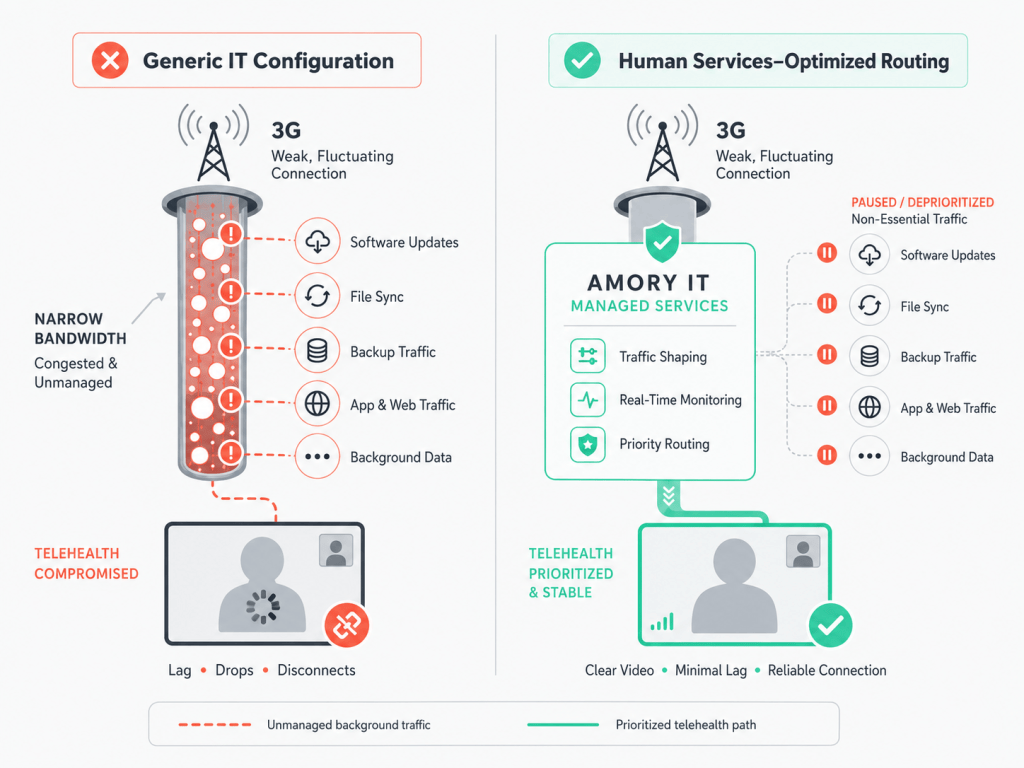
When evaluating external it managed services, your primary filtering criterion must be how the provider handles network volatility. A generic IT company typically advises you to simply upgrade your internet package. However, for organizations operating mobile substance use disorder teams or rural developmental disabilities support networks, upgrading the internet infrastructure in a remote client’s home or a rural community center is impossible.
A comprehensive study hosted by the National Institutes of Health (NIH) emphasizes that broadband discrepancies in rural territories continue to serve as a primary barrier to equitable care access. Because health technology investments lose their efficacy when underlying networks drop below baseline performance markers, your technology stack must be engineered to withstand weak signals.
When interviewing a prospective managed service provider, ask this specific technical question:
“How do you configure mobile devices to maintain Electronic Health Record (EHR) database syncs over a volatile satellite or cellular connection?”
An experienced human services partner will explain how they implement:
- Protocol Prioritization: Configuring field laptops so that heavy background operating system updates wait until the machine is plugged into main office Wi-Fi, keeping the entire limited cellular data pipe open for the EHR.
- Telemetry Scaling: Fine-tuning telehealth systems to automatically scale down video streams to lower bitrates without dropping the active connection entirely when a cell signal degrades.
Security for a Mobile Field Staff
In human services, your digital perimeter is defined by every vehicle, home visit, and community center where your staff interacts with a customer. Every remote laptop and tablet represents a potential compliance liability if it is intercepted, lost, or subjected to an unsecure public network.
When analyzing proposed managed services agreements, verify that the vendor includes centralized Mobile Device Management (MDM) as a baseline feature rather than an expensive add-on. A properly configured MDM allows your technology partner to manage, monitor, and—if necessary—completely wipe a lost field tablet remotely the moment a loss is reported.
This technical alignment protects your operational integrity. Peer-reviewed research focusing on deployment barriers in under-connected environments notes that remote service models only succeed when data protection policies are seamlessly integrated into the physical, everyday environments of the staff members utilizing the tools.
The Security Evaluation Matrix
| Technical Capability | Generic Corporate MSP Focus | Specialized Human Services Focus |
| Network Perimeter | Hardwired office firewalls and static IP office setups. | Encrypted VPN tunnels built for mobile hot-spots and field laptops. |
| Device Security | Basic anti-virus software with manual, user-prompted updates. | Automated, remote-wipe Mobile Device Management (MDM) on every field tablet. |
| Staff Training | Generic, corporate phishing compliance videos. | Context-specific training on handling sensitive client records during remote home visits. |
Aligning Technical Support with Human Operations
The next step in your evaluation framework is auditing the vendor’s actual availability model. Many providers boast about complex “automated ticket queues,” which frequently translate to an offshore chatbot or an automated troubleshooting loop that leaves a staff member stuck without an answer when they are in the field with a client.
A balanced infrastructure model matches the rhythmic workflows of human service organizations, separating standard operating maintenance from critical incident management:
- Human-Led Support Desk: When administrative staff or field teams encounter routine technical hurdles, they connect directly with a live, plain-speech engineer dedicated to getting their systems running immediately. This core help desk operates reliably to address and resolve daily operational roadblocks.
- Remote-First Problem Solving: Because your staff’s time is valuable, the vast majority of technical support is executed safely and swiftly via secure remote-access tools. This keeps workflows uninterrupted and allows immediate intervention regardless of geographic isolation.
- Onsite Engineering as an Intentional Resource: Onsite technical visits shouldn’t be a slow band-aid for routine software bugs. Instead, onsite engineering is leveraged as an intentional, strategic last-resort asset reserved for physical equipment projects, facility installations, or complex network rollouts.
- Emergency Infrastructure Escalation: For catastrophic operational events, your technology partner must maintain an established technical on-call emergency framework. This ensures immediate, around-the-clock access to technical experts exclusively tasked with resolving critical network drops or widespread system outages that threaten organizational continuity outside of standard operations.
Gauging True CARE vs. Transactional IT
The final, and most critical, element of your evaluation cannot be measured on a network speed test. It is the element of cultural alignment. Human services organizations operate on a foundation of empathy, accountability, and respect. Your technology partner must reflect those exact values.
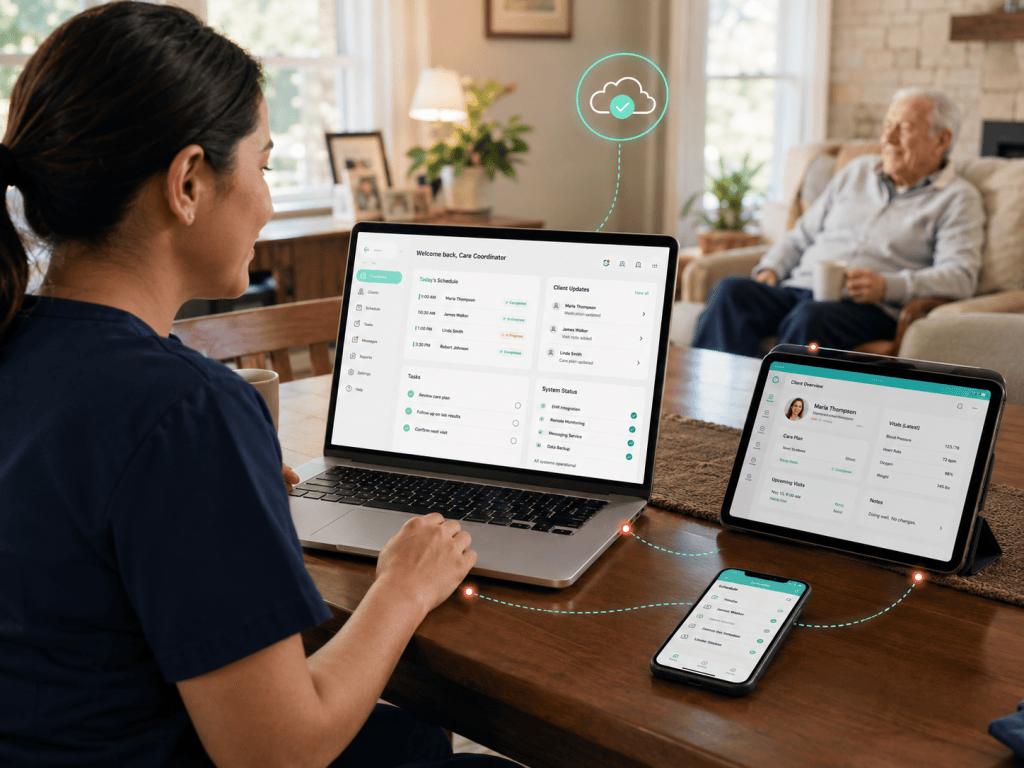
When evaluating an msp, look closely at how their team communicates. A transactional vendor treats your organization like a generic corporate warehouse. An intentional partner takes the time to learn how your substance use, IDD, or elder care programs are structured. They understand that a frozen screen isn’t just an annoyance—it’s a barrier between a staff member and an individual who needs support.

National benchmarks provide an excellent reference point during an IT evaluation. The Substance Abuse and Mental Health Services Administration (SAMHSA) explicitly states that digital infrastructure within behavioral health settings must protect client privacy without creating artificial operational barriers for the staff delivering services.
If a prospective vendor cannot explain how their software configurations map directly to these national integration models, they lack the specialized focus your organization requires.
Build an Infrastructure Worthy of Your Mission
Evaluating IT partnerships doesn’t have to feel like a guessing game. By focusing your search on a partner that understands low-bandwidth rural engineering, prioritizes mobile endpoint data security, and leads with genuine technical empathy, you protect your staff from burnout and keep your data safe.
Let’s build a secure, reliable foundation for your rural care network. Read more about our specialized approach to behavioral health infrastructure on our Amory IT Insights Hub today, or connect directly with our technical strategy team to discover how our tailored managed services can protect, secure, and streamline your community care operations.