- Location:79 13th Ave NE Suite 207 Minneapolis, MN 55413

Beyond the Connection: Building a Reliable Digital Highway for Behavioral Health Workflows
By The Amory IT Editorial Team • 5 Minute Read
Executive Summary: Minor network fluctuations at community residential sites can quietly stall critical compliance data syncs before they ever reach state clearinghouses. For behavioral health, substance use disorder (SUD), and IDD organizations, managing technology across multiple locations requires an intentional strategy. This guide breaks down how a specialized managed service provider (MSP) designs reliable network environments to reduce tech friction and protect your operational workflows.
An IT managed services provider specialized in behavioral health delivers tailored network infrastructure, cybersecurity defenses, and technical support to organizations running distributed residential or community programs. Unlike a standard generalist msp, they design segmented, stable network architectures that minimize data sync disruptions and optimize daily staff workflows.

The Operational Reality: Tracking Data in a Distributed Environment
If you lead an organization specializing in intellectual and developmental disabilities (IDD), substance use disorder, or elder care, your leadership team balances fixed state reimbursement rates with the constant challenge of workforce retention. Yet, an invisible, technical friction point frequently disrupts daily operations without warning.
It happens behind the scenes of your Electronic Visit Verification (EVV) workflows. When a member of your staff finishes a shift at a community residential location and logs their hours via a mobile device, they expect that data to transit seamlessly. However, if the local internet connection faces a momentary drop, that cached data can become stalled.
Under strict hard-edit rules implemented by state clearinghouses across the country, mismatched or delayed verification logs don’t simply trigger a flag for review—they can cause automated claim rejections. While an IT company cannot manage your internal billing codes or prevent human entry errors, an infrastructure failure should never be the reason your data fails to reach its destination. Your staff completed the work and your customers received excellent care, but your administrative team is left untangling a preventable compliance loop.
Protecting your daily operational workflows requires moving away from reactive, fragmented tech fixes. It demands an intentional managed services strategy built to withstand the unique technical pressures of behavioral health delivery.
Why Generic Managed Services Fall Short for IDD Organizations
To build lasting operational health, it is essential to define where technology begins and ends. A managed service provider cannot rewrite your internal compliance policies, and no software application can replace thorough staff training.
Our role as an it managed services partner is to build, monitor, and maintain the underlying digital highway—the routers, firewalls, switches, and access points. When your staff interacts with critical applications, they need a stable, defended pathway to complete their tasks.
“We believe that true IT infrastructure is an act of stewardship. By being Caring, Accountable, Responsive, and Empathetic, we don’t just close technical help tickets—we protect the stable network pipelines that allow your staff to focus entirely on human care.”
— The Amory IT Philosophy
When a standard generalist provider configures these environments, they often treat a community residential site exactly like a standard commercial office or a basic consumer household. According to federal infrastructure frameworks outlined by the National Institute of Standards and Technology (NIST), failing to align network configurations with specific organizational data requirements introduces both security vulnerabilities and performance bottlenecks. A generalist msp simply lacks the context required to protect complex healthcare workflows.
The Technical Architecture of an IT Managed Services Provider
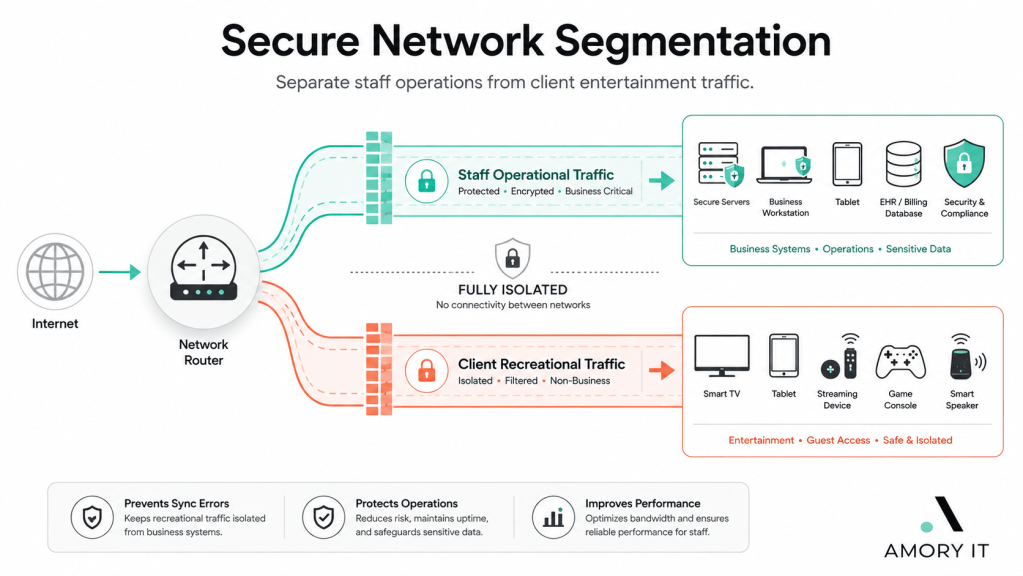
To understand how a specialized provider stabilizes a distributed organization, let’s look at the actual layout of a modern community site. In a shared residential home, your network must support two entirely different operational realities:
- The Staff Workflow: Secure laptops, tablets, and mobile devices used by staff to handle sensitive records, medication logs, and compliance documentation.
- The Client Environment: Smart TVs, gaming consoles, and personal tablets used by your residents to live comfortably, connect with family, and retain independence.
If both groups share a single, unmanaged internet connection, a customer downloading a high-definition video file can unintentionally exhaust the bandwidth your staff needs to sync a critical care log. This is where specialized network design becomes a critical operational safeguard.
A Framework for Scannable Network Health
If you want to evaluate whether your current approach to technology is meeting basic industry benchmarks, you can walk through this three-part structural checklist:
- Problem: Shared Local Bandwidth
- The Consequence: Congested networks cause operational software and EVV applications to freeze, leading to data sync failures and staff frustration.
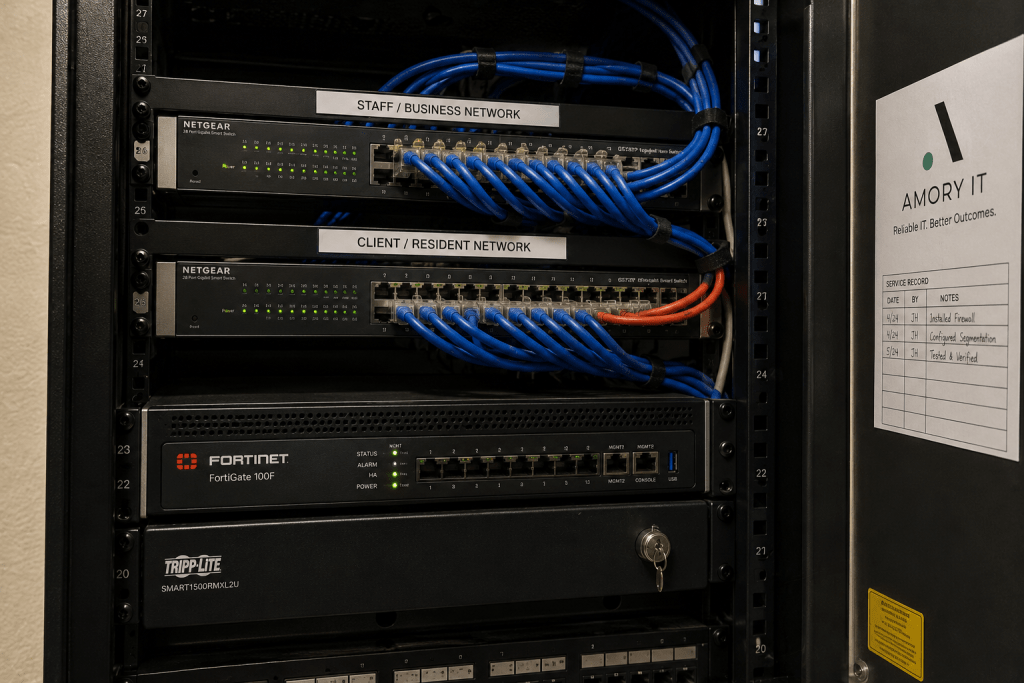
- The Infrastructure Fix: A specialized provider configures Virtual Local Area Networks (VLANs) inside the router. This creates two completely isolated digital tunnels on a single physical internet connection, guaranteeing your staff has dedicated bandwidth.
- Problem: Broad, Unfiltered Device Visibility
- The Consequence: Client entertainment devices can accidentally discover or interact with administrative devices on an unmanaged network, creating an unnecessary security risk.
- The Infrastructure Fix: Strict firewall policies are established so that the client environment cannot communicate with the staff environment, satisfying strict data security frameworks managed by the U.S. Department of Health and Human Services (HHS).
- Problem: Unmanaged Traffic Prioritization
- The Consequence: Heavy recreational data usage takes equal priority over business-critical application synchronization during peak operational hours.
- The Infrastructure Fix: We implement Quality of Service (QoS) rules. This instructs the network hardware to automatically prioritize administrative data traffic above all else, ensuring critical workflows remain online during local usage spikes.
Leading with CARE: Aligning Technology with Mission
Managing infrastructure for organizations that support vulnerable populations requires more than just standard technical certifications. It requires a deep cultural alignment with the teams on the ground. At Amory IT, we filter our technical guidance through our core values, spelling out CARE: Caring, Accountable, Responsive, and Empathetic.
We understand that your staff entered this field to enrich human lives, not to fight with slow logins, frozen screens, and broken application syncs. Industry data tracked by the American Network of Community Options and Resources (ANCOR) emphasizes that workforce stability is the single most critical factor facing modern providers. Administrative burden and technical friction are leading contributors to staff burnout and accelerated turnover in human services.
By resolving technical headaches behind the scenes, we minimize the digital roadblocks that pull your team away from direct interaction with the people you support.
Benchmarking Your Managed Service Provider (MSP)
Choosing the right partner requires assessing how well an IT provider understands the operational realities of the behavioral health space.
| Technical Operational Feature | Standard Generalist IT Firm | Amory IT (Specialist Behavioral Health MSP) |
| Primary Focus | Closing generic hardware and software tickets across various unrelated industries. | Optimizing network infrastructure stability for SUD, IDD, and elder care organizations. |
| Bandwidth Management | Single-stream configurations that invite network congestion and data sync delays. | Advanced network segmentation separating administrative workflows from client recreation. |
| Industry Alignment | Unfamiliar with specific federal guidelines or unique EVV application behavior. | Built entirely around supporting the stable technical pathways required for modern compliance logs. |
| Support Objective | Reactive issue resolution focused solely on closing individual user help tickets. | Proactive infrastructure management designed to eliminate the systemic roots of tech friction. |
Turn Your Technology Into an Invisible Guardrail
Technology should never be a source of constant operational friction or an unpredictable risk factor for your data pipeline. It should be the steady, invisible guardrail that empowers your staff and protects your organization’s daily workflows. When your infrastructure is stable, your data moves reliably, and your staff is unburdened by technical roadblocks, your leadership team can stop playing defensive firefighter and focus entirely on expanding your community impact.
Let’s ensure your underlying network infrastructure is working as hard as your frontline team.
Ready to evaluate your organization’s technical health? Discover how our tailored framework supports your mission by visiting our Specialized Behavioral Health Solutions Hub, where you can learn more about our structural approach or connect directly with our team to map out your multi-site layout.