- Location:79 13th Ave NE Suite 207 Minneapolis, MN 55413

The Dignity of Risk: How Specialized Managed Services Secure IDD Assistive Tech Without Limiting Independence
By The Amory IT Editorial Team • 6 Minute Read
Executive Summary: Intellectual and developmental disabilities (IDD) organizations balance an IT reality unlike any corporate business. To support client independence, your residential facilities and day programs are filled with smart environmental controls, specialized communication tablets, and shared staff hardware. When generic IT support firms try to protect this space, they typically lock down the environment so harshly that clients lose access to their assistive tools. This guide outlines how an industry-specific managed service provider (MSP) engineered an alternative approach: securing organizational infrastructure while honoring client autonomy.
A specialized managed service provider for IDD organizations must protect sensitive corporate records while simultaneously keeping client-facing assistive technologies fully operational. While generalist IT support providers often block non-standard hardware, an experienced behavioral health msp utilizes tailored network isolation frameworks. These custom managed services allow Augmentative and Alternative Communication (AAC) devices, smart home automation, and shared shift-change tablets to run securely without risking regulatory data compliance.
The Paradox of Choice: When Security Clashes with Autonomy
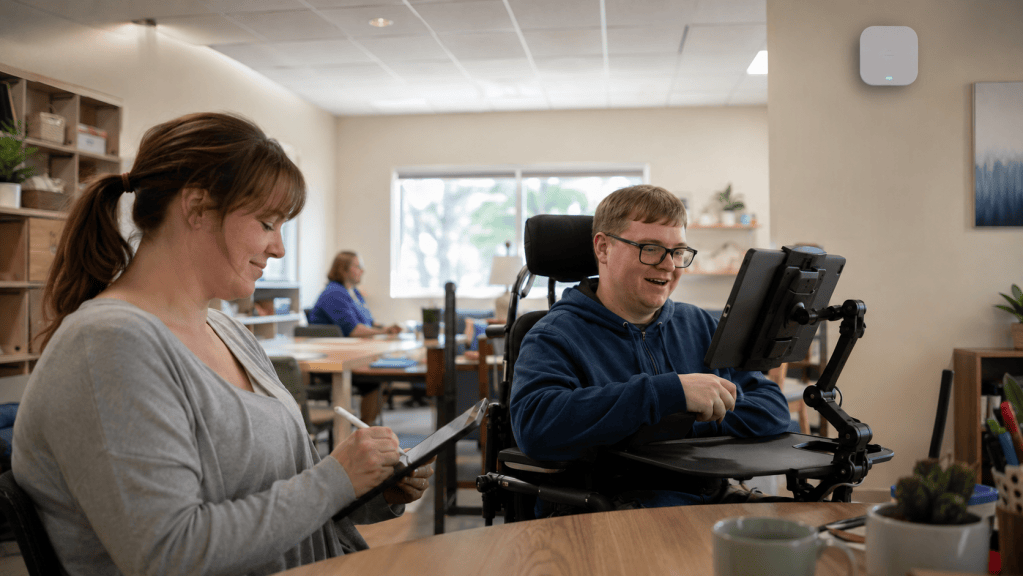
Inside a modern community living home or day habilitation space, technology is the ultimate tool for client self-advocacy. A voice-activated smart speaker allows an individual to control their bedroom lights; an adaptive thermostat provides environmental control; and an Augmentative and Alternative Communication (AAC) tablet provides a literal voice.
Yet, to a standard commercial technology vendor, this ecosystem of consumer-grade electronics looks like an unmanaged security vulnerability. Every smart plug, streaming stick, and adaptive device expands your digital attack surface. When generalist IT firms are hired to provide IT Support, their default response is often to implement rigid, corporate-grade lockdowns. They block unauthorized hardware, restrict wireless connections, and enforce complex password policies that are impossible for independent clients or rotating staff to seamlessly navigate.
This creates an unnecessary operational failure. By treating an IDD group home like a standard corporate branch office, traditional IT companies inadvertently strip away the digital tools that foster human independence. Security should never come at the cost of client dignity. According to the official AAIDD Position Statement on Technology and Internet Access, individuals with cognitive disabilities must have unhindered access to affordable, usable, and commercial off-the-shelf technologies to maximize their integration into society. Your organization needs an IT strategy built on the principle that data compliance and client autonomy can safely live on the same network.
Achieving this balance requires moving away from reactive troubleshooting and partnering with an organization that provides specialized managed services engineered specifically for the behavioral health and developmental disabilities landscape.
Where Infrastructure Ends and Care Begins
Protecting this delicate balance requires setting clear boundaries on what professional managed services should achieve. A technology company should never dictate how your organization delivers person-centered care, nor can software replace the intensive training required for Direct Support Professionals (DSPs).
Our responsibility as a specialized managed service provider is to engineer the underlying digital foundation. We design, defend, and monitor the network infrastructure—the firewalls, isolated wireless lanes, device management profiles, and cloud backup systems.
“Technology in human services should behave like an invisible guardrail, not a locked gate. By aligning our infrastructure designs with our core values of being Caring, Accountable, Responsive, and Empathetic, we ensure your digital pipeline is completely secure, leaving your staff free to focus on what truly matters: human connection and client growth.” — The Amory IT Philosophy
When generic IT firms step into the behavioral health space, they lack the structural understanding of how client-facing technologies interact with organizational data systems. According to federal accessibility standards established by the U.S. Department of Health and Human Services (HHS), electronic environments must remain accessible to individuals with disabilities. A specialized msp builds an ecosystem where compliance and accessibility live together safely.
The Three-Tier Architecture of Inclusive Security
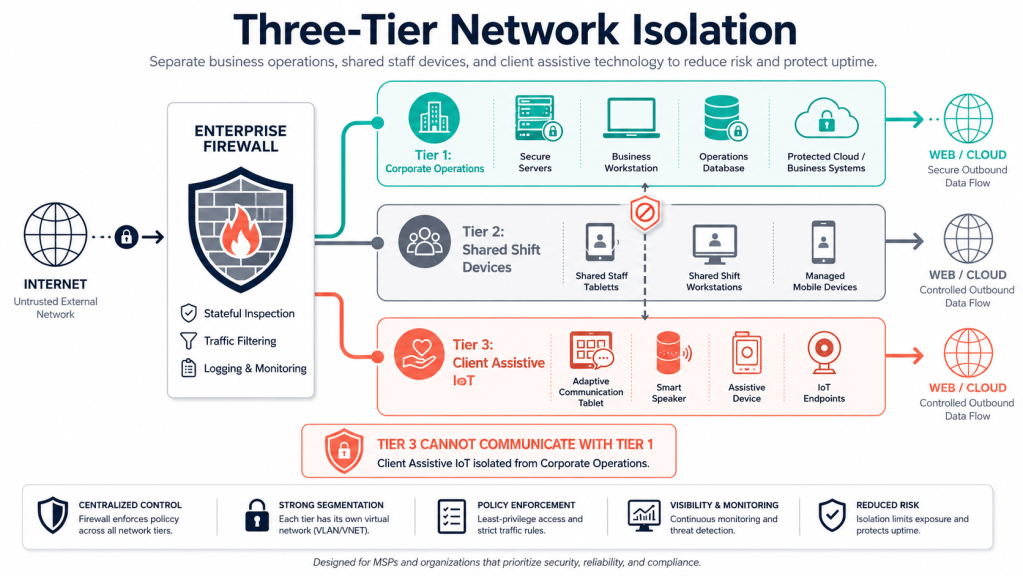
To keep your organization audit-ready without compromising client independence, a specialized managed services strategy abandons the traditional “single corporate network” model. Instead, we implement a customized Three-Tier Network Isolation model specifically engineered for multi-site human services providers.
Tier 1: The Corporate Operations Pipeline
The Target Assets: Executive laptops, human resources data, centralized accounting databases, and financial billing platforms.
The Security Profile: This segment uses strict zero-trust access rules. It is entirely hidden from the rest of the house. Even if someone physically plugs an unmanaged laptop into a wall jack in a residential living room, they cannot see or ping this data lane.
Tier 2: The Shared “Shift-Change” Device Lane
The Target Assets: The shared tablets, smartphones, or computers utilized by changing shifts of staff to log daily habilitation records, incident reports, and medication compliance logs.
The Security Profile: Shared devices are a major operational friction point. When multiple staff members share a single tablet over a 72-hour weekend rotation, password hygiene often falls apart. We secure this tier using Mobile Device Management (MDM) applications that utilize simplified, secure biometric or pin-based user switching. The data entered is pushed directly to your secure cloud database, leaving zero client data cached locally on the device if it is accidentally lost during a community outing.
Tier 3: The Independent Client & Assistive Tech Environment
The Target Assets: Voice-activated smart home platforms, personal entertainment consoles, adaptive environmental controls, and speech-generating apps (such as Proloquo2Go or custom AAC hardware).
The Security Profile: This network tier is optimized for accessibility and device interoperability, following technical baselines established by the NIST Cybersecurity for IoT Program to ensure connected consumer electronics don’t introduce vulnerabilities into adjacent networks. Devices within this lane can communicate with one another freely—allowing a client’s tablet to control their bedroom smart speaker—but an ironclad firewall policy blocks this entire tier from communicating with your corporate systems. If a client-owned device is ever compromised by malware, the threat is trapped entirely inside Tier 3, keeping your organizational records completely untouched.
Preserving Custom Communication Profiles
A major operational pain point for IDD organizations is the mismanagement of specialized client hardware. For an individual who relies on an AAC device, their tablet isn’t a piece of corporate office equipment—it is their literal voice. These devices accumulate years of custom vocabulary configurations, personalized icon placements, and tailored phrases unique to that individual.
When standard corporate IT teams handle these devices, they often run automated patches or device wipes that can accidentally delete these critical personal configurations.
Our specialized approach treats these devices with the distinct care they require. Through targeted MDM rules, we lock down operating system settings to protect against accidental changes while keeping the user’s specialized communication apps completely untouched. Backups of custom vocabulary maps are maintained separately, ensuring that if a speech device experiences a hardware failure, the individual’s personalized voice can be restored to a replacement device seamlessly.
Aligning Technical Strategy with Operational Realities
Selecting an IT partner requires assessing how well a vendor’s technical delivery matches the daily workflows of your staff and clients.
| Core Operational Metric | Generic Commercial IT Firm | Amory IT (Specialist IDD Partner) |
| Assistive Tech Integration | Treats client speech devices and smart tech as security threats to be blocked. | Isolates assistive tech into secure, independent network tiers that preserve client autonomy. |
| Shared Hardware Management | Enforces rigid corporate logins that lead to password sharing and documentation lag. | Deploys mobile device management with streamlined, secure user switching for shift changes. |
| Data Protection Philosophy | Implements standard corporate lockdowns that ignore client accessibility needs. | Designs custom security boundaries that protect corporate data while honoring the dignity of risk. |
| Support Desk Orientation | Metric-driven ticket queues staffed by technicians unfamiliar with human services software. | Support frameworks guided by empathy, designed to reduce technical friction for your frontline staff. |

Build an Infrastructure for Progress and Independence
Your network infrastructure should never force your leadership team to choose between data compliance and the personal independence of the people you support. It should act as a reliable, secure foundation that protects your records while empowering your clients to confidently engage with the world. When your assistive technologies are safely managed, your shared shift hardware is secured, and your staff is unburdened by technical friction, your organization can move away from managing tech issues and focus entirely on expanding your community impact.
Let’s transform your technological ecosystem into a secure foundation for growth and independence.
Ready to evaluate your organization’s device security? See how our tailored frameworks protect your multi-site operations by exploring our Specialized Behavioral Health Solutions Hub. Learn more about our technical strategies or reach out directly to our engineering team to design a secure device management blueprint for your locations.